
What Makes a Bed Frame Quiet?
Share
Short answer: a quieter bed frame starts with secure joints, evenly supported slats, stable contact with the floor and a mattress that fits the frame. Construction can reduce opportunities for movement, but no bed frame should be described as permanently silent under every floor, mattress and pattern of use.
Why can a bed frame make noise?
Bed-frame sound usually begins with movement between two surfaces. A connection may have loosened, a slat may not be fully seated, the frame may be standing on an uneven floor, or another object may be touching the frame. The mattress or foundation can also be the source, so it is useful to isolate the cause before changing the bed.
Six things that influence bed-frame noise
- Joint fit. A well-seated connection reduces unnecessary movement between the rails and legs.
- Number of loose fasteners. Every removable fastener is a point that may need inspection over time. Fewer fasteners can make that inspection simpler, although the complete structure still matters.
- Slat contact. Slats should sit in their intended position and be supported evenly.
- Center support. Larger sizes may use a different support layout to distribute load through the middle of the frame.
- Floor level and contact. A stable frame can still move if one foot is not making consistent contact with the floor.
- Nearby objects. A frame touching a wall, nightstand or baseboard can transfer movement and create sound.
How does interlocking wood joinery help?
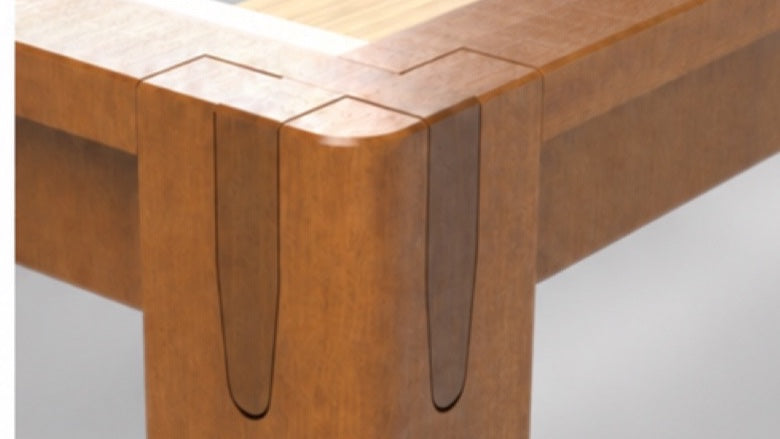
Interlocking joinery increases the contact area between connected wood components and gives the pieces a defined seated position. The U-shaped corner connection used by Brintavo is intended to limit unwanted movement at the outer corners while keeping assembly simple. This design approach can help with stability, but it is not a promise that a bed will never make a sound.
The Brintavo solid rubberwood platform bed frame uses this interlocking connection at the main frame. Twin and Twin XL do not use extra screws in the frame connection. Queen adds a longitudinal center support and two large fasteners designed to be tightened by hand. No screwdriver is required.
What should you inspect before buying?
- Clear photos or diagrams of the joints.
- The support layout for the exact size you are buying.
- Whether assembly instructions are size-specific.
- The material used for the main frame and the slats.
- Whether performance language is a measured claim, a design explanation or a customer-reported theme.
That last distinction matters. A verified test result should identify how it was tested. A customer review should be labeled as a customer experience. A design explanation should describe the construction without turning it into an absolute guarantee.
How to troubleshoot a noisy bed frame
- Remove bedding and check whether the sound comes from the mattress or the frame.
- Move the frame slightly away from the wall and nearby furniture.
- Confirm that every frame connection is fully seated.
- Check that the slats and any center support are in their intended positions.
- Confirm that all feet contact the floor evenly.
- Recheck any fasteners supplied for that specific size.
Do not force a wood connection or add unapproved hardware. If a component is damaged or does not seat correctly, contact the seller with photos of the part and the connection point.
Frequently asked questions
Does solid wood guarantee a quiet bed?
No. Material is only one part of the system. Joint fit, support layout, floor contact, assembly and the mattress all influence movement and sound.
Do more screws make a bed more stable?
Not necessarily. Stability comes from the complete structure and the way its connections carry load. The number of fasteners alone does not determine performance.
Should a bed frame touch the wall?
It does not need to. Leaving a small gap can help identify wall contact as a possible source of sound and may protect both the frame and the wall.
For routine wood care that helps preserve the finish around joints and rails, see how to care for a solid rubberwood bed frame.